
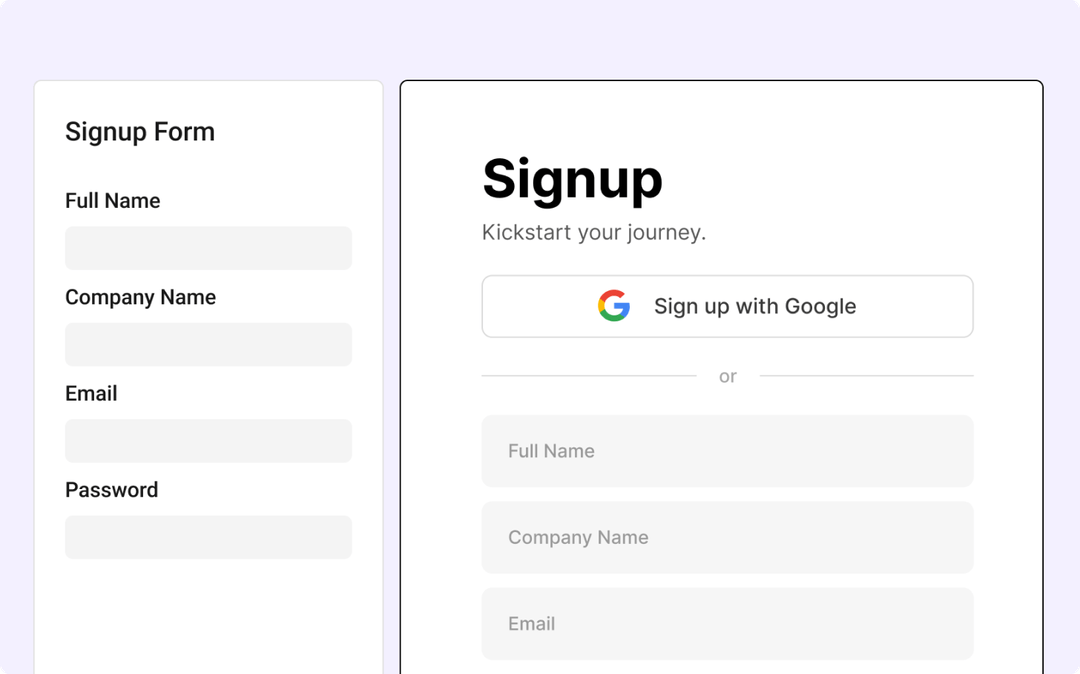
Define the minimum information required to start
Most onboarding forms are either too vague or exhausting. Work backward from the first delivery milestone and ask only for information that changes how you begin. An SEO audit needs the domain, analytics access, business priorities, and known constraints. A brand sprint needs existing assets, audience, decision makers, and references. Everything else can be requested when it becomes relevant.
- Name the first milestone before writing questions
- Ask for facts that change the initial plan
- Separate required inputs from useful background
- Remove questions that you never use during delivery
Put the sequence in one visible place
The client should know what has happened and what comes next: package selected, payment confirmed, intake submitted, files received, kickoff scheduled, first milestone due. A portal reduces repeated status questions because the sequence is visible. Keep welcome messages short and action-oriented; clients should not need to interpret a long email before they can proceed.
- Show the purchased package and current status
- List the next action with an owner and due date
- Keep uploads and project context together
- Explain where support requests should go
Use conditional questions instead of one giant form
Different offers need different intake. Route clients from the exact service link so they see only relevant questions. Ask follow-up questions when an answer creates a genuine branch, such as a CMS choice, campaign status, health constraint, or licensing need. This makes the experience feel tailored without requiring manual setup for every client.
- Create a separate intake path for each core offer
- Use niche and package context in the signup URL
- Ask conditional questions only when they change delivery
- Save answers with the client and project record
Automate reminders without automating the relationship
Automate confirmations, missing-input reminders, task creation, and internal notifications. Keep diagnosis, reassurance, and important expectation-setting human. A good rule is to automate predictable state changes and personally handle messages where tone or judgment affects trust.
- Automate payment and intake confirmations
- Remind clients about specific missing items
- Create the project and standard tasks automatically
- Send personal messages for risk, ambiguity, or sensitive context
Design the first 48 hours
Speed after purchase shapes confidence. Immediately confirm the order and next action. Within one business day, review the intake and acknowledge anything unusual. Within 48 hours, confirm the first milestone or explain what is blocking it. Even when delivery starts later, the client should feel that the process is active and owned.
- Immediate confirmation with one next action
- Human intake review within one business day
- First milestone or blocker confirmed within 48 hours
- One named place for future questions
Audit onboarding with five operational metrics
Track completion rate, time from payment to completed intake, number of reminder messages, time to first milestone, and questions that appear after kickoff. These reveal whether the workflow is actually reducing friction. Improve one repeated problem each month rather than adding more fields or automation without evidence.
- Intake completion rate
- Hours from payment to ready-to-start
- Average reminders per new client
- Time to first milestone and repeated kickoff questions
Choose one operational definition of success
Before changing the workflow described in this guide, write down the decision or behaviour that should improve and the evidence that would justify that conclusion. The primary measure is time from payment to a complete first milestone, supported by intake completion and clarification volume. Record the definition, baseline, measurement window, and owner before changing the process. Add a small number of diagnostic signals only when they explain the commercial result. This prevents freelancers and small expert-led teams from replacing vague activity with a more elaborate dashboard that still cannot guide the next decision.
- Primary measure: time from payment to a complete first milestone, supported by intake completion and clarification volume
- Record the baseline before changing the process
- Use the same definition before and after
- Name who reviews the evidence and decides what happens next
Turn the advice into a fixed starting engagement
A reader should be able to use this guide independently, but some buyers will need expert diagnosis and implementation. A credible first paid step is a client onboarding friction and readiness audit. Publish who it is for, the question it resolves, the evidence reviewed, the deliverable, timeline, price, and exclusions. Keep it small enough to create a real decision before a larger commitment. This gives the client a useful result and lets the specialist qualify fit without writing unpaid custom strategy for every enquiry.
- Starter offer: client onboarding friction and readiness audit
- Promise one decision, plan, or visible result
- State price, timeline, dependencies, and exclusions
- Connect the package directly to its own onboarding path
Collect the minimum evidence required to begin
Work backward from the first useful decision and request only information that changes how work starts. Explain why each sensitive input is required, who can access it, and how missing context affects the timeline. Review the intake within one business day and ask focused follow-up questions inside the client record. Long generic questionnaires create abandonment while still missing the evidence the expert needs. For this workflow, the starting brief should cover the following inputs.
- purchased offer
- required decisions
- minimum starting assets
- client and internal owners
- first milestone
- exception and escalation path
Run a pre-mortem before automating or scaling
Imagine the work has produced a poor client outcome despite being delivered on time. Identify the assumptions, access gaps, approval failures, and misleading measures most likely to cause it. Turn each risk into a scope boundary, checklist item, review gate, permission rule, or visible exception path. The goal is not bureaucracy. It is to preserve the judgment the client is paying for while making repeated delivery safer and easier to improve.
- Prevent using one generic questionnaire
- Prevent asking for information before explaining why
- Prevent collecting sensitive data without controls
- Prevent starting delivery with unresolved dependencies
Use AI as an assistant with a named human owner
AI can accelerate research, classification, transformation, drafting, and repetitive analysis, but it should not obscure responsibility. Decide which inputs are permitted, what claims require verification, where first-hand expertise must replace generated language, and who approves the final output. Keep confidential client material out of unapproved systems. Save the source, prompt context, material edits, and final decision when the work affects a client recommendation. The efficiency is only real after review and correction time are included.
- Classify client data before using an AI tool
- Verify changing facts against primary sources
- Keep diagnosis, exceptions, and sensitive communication human
- Measure time saved after review, correction, and failure handling
Create proof a future buyer can inspect
A polished final screenshot is not enough. Build an offer-specific onboarding path that records what is collected, why it matters, who reviews it, the first milestone, and what happens when an input is missing. Explain the starting condition, relevant constraint, expert decision, implementation, measurement window, result, and what remains uncertain. Remove confidential details and do not imply causation the evidence cannot support. Strong proof helps a future buyer understand how you think, while a current client can see what changed and why the next recommendation is relevant.
- Show the starting condition and commercial context
- Name the expert decision and the rejected alternative
- Use the agreed success definition
- End with who should use the approach and who should not
Design the continuation before the first engagement ends
The natural next service is monthly client-operations and onboarding optimization. Introduce it when the first result reveals an ongoing need, not as a surprise after the project closes. Define what is reviewed or delivered each cycle, how priorities are chosen, what capacity and response boundaries apply, and how the client can pause or change scope. A useful recurring offer protects, extends, or repeatedly produces an outcome. Undefined access to the freelancer is not a durable retainer.
- Continuation: monthly client-operations and onboarding optimization
- Ongoing measure: time from payment to a complete first milestone, supported by intake completion and clarification volume
- Set a clear cadence, capacity, and response boundary
- Review relevance before renewal or material scope change
Use this two-week field plan
Days one and two: document the current workflow and baseline. Days three and four: package the client onboarding friction and readiness audit, including scope, price, exclusions, and evidence required. Day five: build the offer-specific intake and first milestone. During week two, invite a small number of relevant clients, past clients, or warm prospects to review or buy the package. Deliver the first useful decision, record every hesitation, and improve the offer before increasing promotion. This creates a live learning loop instead of another planning document.
- Publish one small paid starting offer
- Prepare the first milestone before promoting it
- Invite only buyers for whom the problem is relevant
- Revise the package from real questions and delivery evidence
References used in this guide
These sources support claims that may change over time. The practical recommendations and operating framework are Retainr's editorial synthesis.